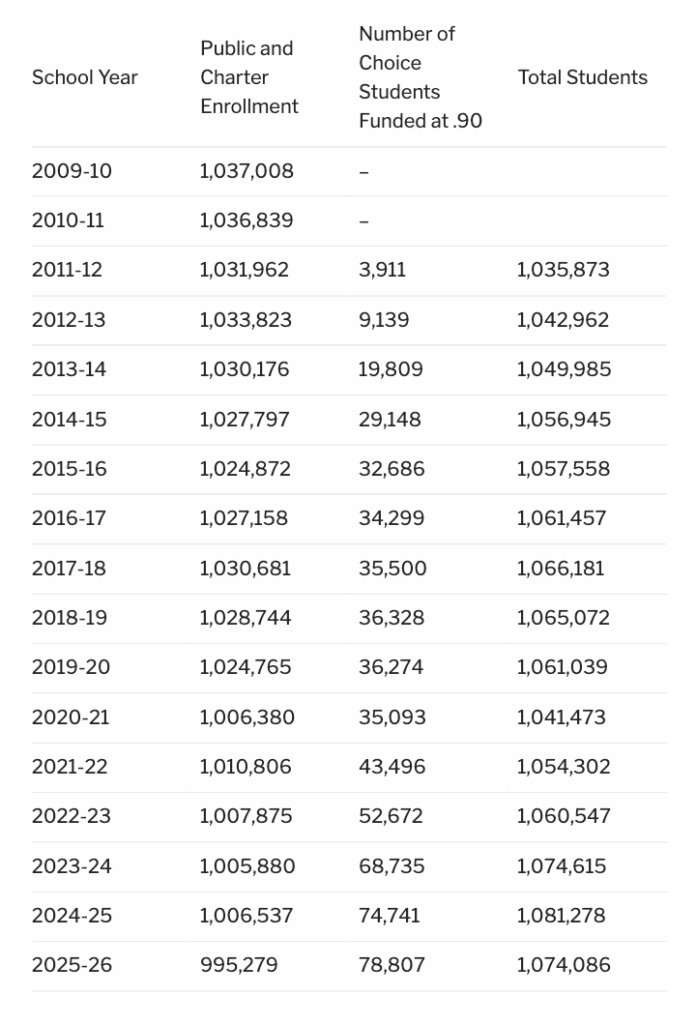
Despite having 15,349 fewer children in the state overall, Indiana is now funding the education of 37,078 more students (as of 2025-2026 school year) across many more schools. This is due to the state’s broad “school choice” policy where the “money-follows-the-child,” which diverts public funds to charter and private schools.
The state’s largest voucher program, the Choice Scholarship Program, is a significant part of this. Without it, and if Indiana’s public and charter students were funded at an inflation-adjusted rate from the 2009–10 school year, THE STATE WOULD SAVE $153 PER STUDENT AND EACH STUDENT WOULD GET $473 MORE. Yes. You read that right. If the Voucher Program did not exist and Indiana funded its public and charter students at an inflation adjusted rate from 2009-10, the 995,279 students, each at the inflation adjusted rate of $9,261, would result in a tuition support budget of $9,217,710,875.47. This would DECREASE the budget by $152,289,125, and would be an increase of around $473 budgeted per public and charter school student.
This is new. Funding the ever-growing Voucher Program is not just taking money from public and charter students, it is now taking money from taxpayers. In the past, if the state eliminated the Choice program, they still needed to add a little money to get to the per student allocated amount vs inflation. This year taxpayers would fund the public and charter school students appropriately AND save money. Maybe even property tax dollars because the bump in state funding would eliminate the need for referenda in some communities.