Who Will Protect the Most Vulnerable Students?
What Indiana’s F Grade, a New Federal Waiver, and Changes to the U.S. Department of Education Could Mean for Students and Public Education
This past week brought three major education stories that, taken together, reveal a troubling trend for public education in Indiana and across the nation.
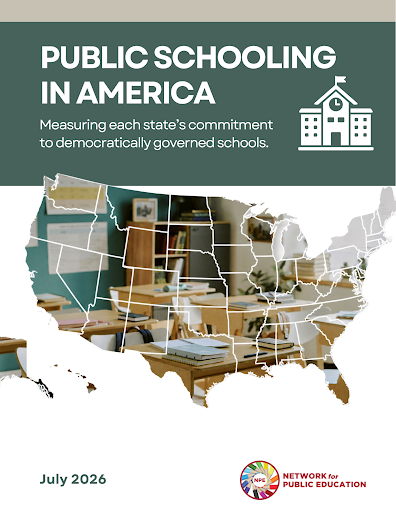
First, the Network for Public Education’s 2026 Report Card gave Indiana an F for its support of public schools. The annual report card grades each state legislature based on four categories: privatization of public education, school funding, the conditions for teaching and learning, and protections for homeschooled students.
Secondly, Indiana became one of the first few states in the nation to receive a federal “Returning Education to the States” waiver, granting state officials greater flexibility over how federal education dollars are spent by combining targeted funds into one. It also allows the state to determine how schools will be evaluated for accountability purposes.
At the national level, a third news story was the announcement that the Trump administration plans to move federal oversight of special education and educational civil rights enforcement out of the U.S. Department of Education and into other federal agencies—another step towards making good on the president’s promise to dismantle the federal department of education. For Indiana, these three developments raise an important question: If these trends continue, how will the state’s public schools be able to provide all Hoosier students—particularly those with disabilities and those living in poverty—with the education, protection and resources they deserve?
Indiana’s F Grade reflects a choice by the legislature
According to the 2026 Network for Public Education Report Card, Indiana has become one of the nation’s leading examples of education privatization. School privatization is the transfer of public funding and control from public schools to private entities that operate with less transparency and public accountability. It leaves public schools, which are open to all students, with less funding.
The NPE report cites Indiana’s expansive voucher program, growing diversion of public funds to private schools, lack of oversight for publicly funded private education providers, and insufficient support for public schools as the basis for the F grade. This did not happen overnight.
Over the past 15 years or so, Indiana legislators have steadily expanded voucher eligibility and other forms of publicly-funded privately run education. Beginning with the 2026–2027 school year, every Indiana family—regardless of income—will be eligible to receive taxpayer-funded assistance for private school tuition. In addition, by 2028, property tax revenue currently meant for traditional public schools will have to be divided among eligible charter schools in their district.
At the same time, public schools continue to face mounting financial pressures. School corporations are absorbing the effects of SEA 1 property tax reductions, inflationary costs, unfunded mandates, and this continued expansion of voucher and charter programs. Many districts are expected to seek local referendums simply to maintain current operations and services.
It is vitally important to note that public schools remain responsible for educating every student who arrives at their doors. They provide transportation, special education services, career and technical education, extracurricular opportunities, and countless supports that strengthen our communities. They are the only schools that are, as directed by our state constitution, “equally open to all.” Yet the legislature continues to funnel increasing amounts of taxpayer funding toward privately operated education options that are not subject to the same transparency and governance requirements as public schools.
Flexibility or Accountability?
When the federal government approved Indiana’s “Returning Education to the States” waiver this week, Governor Mike Braun praised the move:
This gives us pause. There is a good argument to be made that reducing federal bureaucratic red tape may allow schools to spend less time on paperwork and more time serving students. And it is also true that local educators and policymakers are in the best position to determine how federal dollars should be used locally. Flexibility can be valuable.
However, flexibility and accountability are not opposing ideas. We are glad to see that the federal government denied the part of the Indiana waiver that would have allowed these funds to be diverted to charter schools and away from public schools that serve students in poverty. Our worry is that this move is a “step,” as the governor suggests, in that direction.
We will have to be vigilant. Historically, federal funding has come with requirements for reporting to ensure that targeted funds go to the students for whom they are intended. We hope that this accountability for different students and their needs will still remain—and be visible. The federal government’s role in education has never been to run local schools. Its role has been to ensure that every child—regardless of gender, ability, family income, race, or background—has access to educational opportunity and that students’ civil rights are protected.
Protecting and supporting vulnerable students
This past week also saw the announcement from the Trump administration that oversight of special education and civil rights will be removed from the Department of Education and placed in other agencies. This is yet another step in dismantling and eliminating the department, as promised by the president through an executive order last year.
It is important to remember that before the U.S. Department of Education was created, schools all across the country often struggled or failed to provide appropriate or high quality education for students with disabilities, English language learners, and kids living with the effects of poverty. Vulnerable students needed support and resources. Racial achievement or opportunity gaps were large.
Federal programs with title funds and IDEA have worked toward ensuring educational equity is accessible for all kids. Before these protections existed, many students with disabilities were excluded from public schools altogether. Students from low-income communities often attended severely underfunded schools with limited resources. Families had few avenues for recourse when discrimination occurred or when schools failed to provide or were unable to provide appropriate services. The federal Department of Education exists in part because history showed that vulnerable students too often fell through the cracks when there was no meaningful federal oversight.
That history is why the recent decision to move special education oversight and civil rights enforcement out of the Department of Education raises grave concerns about protecting students. If accountability is weakened as a result of this move, the students most likely to be affected are vulnerable students whose educational opportunities have historically depended upon strong federal protections.
We sincerely hope that what the governor implies is wrong and that public funds will stay with the public schools that are required to serve all children. We hope the role of federal oversight is not reduced with this waiver and subsequent flexibility. We must all be vigilant to ensure that students most in need of support will continue to receive it.
A Common Thread
Last week’s news announcements reflect a steady transfer of educational authority away from systems of public accountability. Indiana knows all too well that, as with the transfer of public funding away from the public schools, the transfer away from public oversight in education hurts the most vulnerable students with the greatest needs. Local control means little if local communities lack the resources necessary to support their students—all students.
Indiana may indeed wish to “set the standard” for education in America. But the true measure of that standard should not be how much flexibility government agencies have or how much so-called “choice” exists in education. It should be the ease of access and strength of support for all students, regardless of background. It should be how effectively we protect the rights and educational opportunities of the students who need support the most. It should be about the strength of the high quality, free, open-to-all public education guaranteed by our state constitution.
Public funds should come with public oversight. Student protections should remain enforceable. These things work in tandem to ensure that the promise of public education is fulfilled for all students. Every child deserves access to a high-quality public education system that is transparent, equitable, and accountable to the public it serves.
History shows why federal oversight was created in the first place: too many children were being left behind. As Indiana embraces greater flexibility and the federal government retreats from long-standing oversight roles, the legislature must ensure that the students who depend most on public education—students with disabilities, students living in poverty, and students whose civil rights require protection—do not become collateral damage in the pursuit of deregulation and privatization.