Funding, Local Control and the Future of Public Education
Funding, Local Control and the Future of Public Education: Recap of ICPE’s 16th Annual All-Member Meeting
We held our 16th Annual All-Member Meeting on Wednesday, September 23, 2026, bringing together members and public education supporters from across Indiana to look at the challenges facing our public schools. Importantly, we talked about the work that we–and you– are doing to meet them.
This year’s meeting moved from our traditional August in-person gathering in Indianapolis to a virtual September event, making it easier for parents, educators, advocates, and community members from across the state to participate.
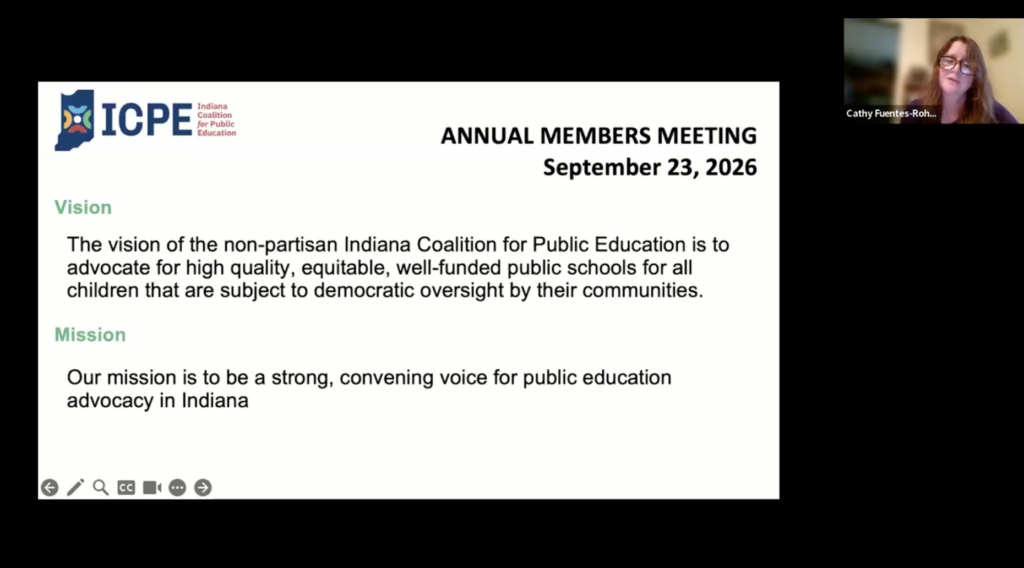
President Cathy Fuentes-Rohwer opened the meeting by highlighting the work ICPE members and volunteers have accomplished throughout 2026, including grassroots organizing, legislative advocacy, community outreach, and the development of new tools to help Hoosiers understand the impact of education policy.
We then discussed a few issues that will continue to shape public education in Indiana: local democratic control of schools, voter information, school funding, and the 2027 legislative session.
ICPE’s Work: Showing Up Across Indiana
Since our last annual meeting, ICPE members and advocates have participated in events throughout Southern, South Central, East Central, Northeast, and Northwest Indiana. The organization hosted 20 Sunday night grassroots “quick chats” with members from across the state. Regional advocates, like the Experienced Educators of East Central Indiana and ICPE South Central Indiana, organized local events, community outreach, and postcard parties.
During the legislative session, we hosted four virtual rapid-response Action Parties. Advocates made hundreds of calls and emails to legislators and hundreds more grassroots contacts through “friend banking.” We also issued 11 calls to action and Statehouse notes on legislation that mattered most to public education.
Behind the scenes, a volunteer bill-tracking team followed 61 education bills, providing the groundwork for our legislative alerts and calls to action.
ICPE lobbyist and general counsel Joel Hand testified 12 times, helped legislators with 23 amendments, and one accountability bill. In addition, Hand influenced amendments to 6 bills, making the bills better.
Our public-facing reach continues to grow as well. We now have more than 11,000 Facebook followers and more than 9,000 Hoosiers visited our website during 2026. Our ICPE online tools illustrating the defunding of public schools –especially those examining the impact of vouchers and SEA 1 by school district– helped drive that traffic to our site.
Elected School Board, But No Power: The Indianapolis School Board Takeover
Nigel Long presented a preview of his team’s presentation, “Elected School Board, But No Power: The Takeover of the Indianapolis School Board,” which was later presented at the Network for Public Education’s 2026 National Conference in Houston.
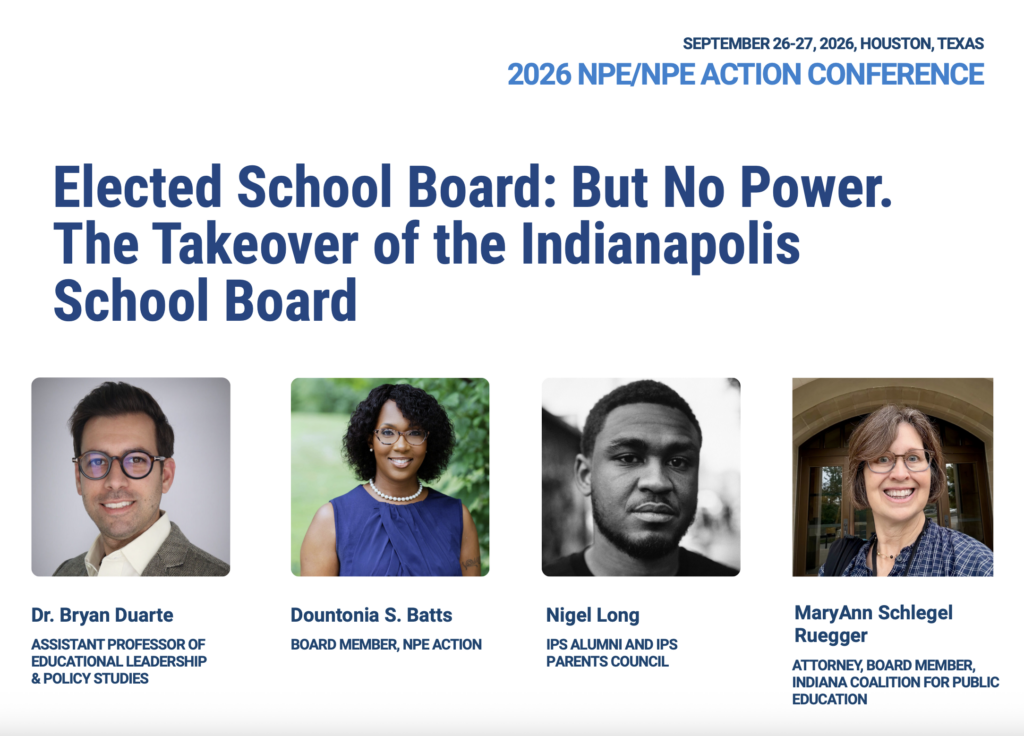
Long traced the current dramatic changes to public education governance in Indianapolis Public Schools dating back to the Unigov era in 1970 which was when the state legislature, with the cooperation or at the behest of the mayor, consolidated the city and county townships to create one government, effectively diluting the power of the Black community. The schools of these communities, however, remained separate.The erosion of Indianapolis Public Schools (IPS) has been a long game.
Long discussed the current state of IPS and what he sees as a significant shift in the balance of influence over the district during the past two decades. He highlighted the growing influence of billionaire-backed outside organizations, including The Mind Trust and Stand for Children, and argued that these organizations and others have played an increasingly significant role in shaping school board decisions and public education policy. He questioned whether terms such as “equity” and “innovation” are used to advance policies without sufficient public discussion or democratic accountability.
He also highlighted an important reality: It is difficult to fight a well-funded movement without money.
Looking ahead to the October 3 election, Long encouraged parents and community members to look closely at school board candidates—including their positions and sources of financial support—and to understand the broader forces shaping local school governance. A good resource for information on the IPS elections is the IPS Parent Council.
The Indianapolis experience raises broader questions that extend beyond a single school district: Who should make decisions about public schools? Who should be accountable to the community? And what does local democratic control mean when significant decisions about public-school facilities, transportation, and other functions are stripped from the authority of an elected school board?
#VotePublicEd: Giving Voters Information
Keri Miksza presented ICPE’s 2026 Candidate Pledge and Legislative Scorecard, two tools designed to help Hoosiers understand where candidates and incumbent legislators stand on public education issues.
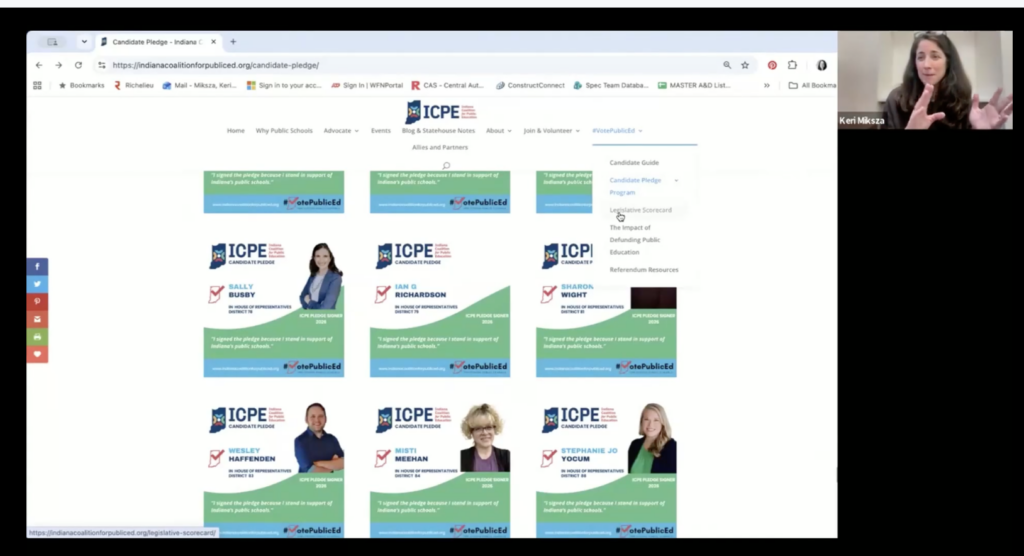
The Legislative Scorecard reports how incumbent legislators voted on selected bills from the 2025 and 2026 legislative sessions. The bills were selected because they involved issues including public-school funding, public control of education, and the use of taxpayer dollars for K-12 education. ICPE emphasizes that the Scorecard reports legislators’ votes but does not assume their reasons for voting as they did. Sometimes a bill didn’t go far enough for a legislator. We recommend doing your homework!
We also offer the Candidate Pledge.
The 2026 pledge asks Indiana General Assembly candidates for five commitments:
- Prioritizing traditional public schools when funding education
- Supporting fiscally conservative spending caps on existing voucher programs
- Rejecting further diversion of funds away from traditional public schools
- Preserving the authority of locally elected school boards
- Ensuring consistent transparency, accountability, and oversight for all entities receiving taxpayer-funded K-12 dollars
Please remember, signing the pledge does not constitute an endorsement. Rather, the program gives candidates an opportunity to publicly state their positions and gives voters information they can use when evaluating candidates.
With the 2026 election approaching and the 2027 legislative session ahead, these tools are intended to help Hoosiers ask candidates where they stand on the future of public education.
A Funding Crisis: The 2026 School Funding Survey
Jim May, ICPE vice president, presented findings from ICPE’s second annual School Funding Survey, offering a direct look into the experiences of Indiana’s traditional public school superintendents.
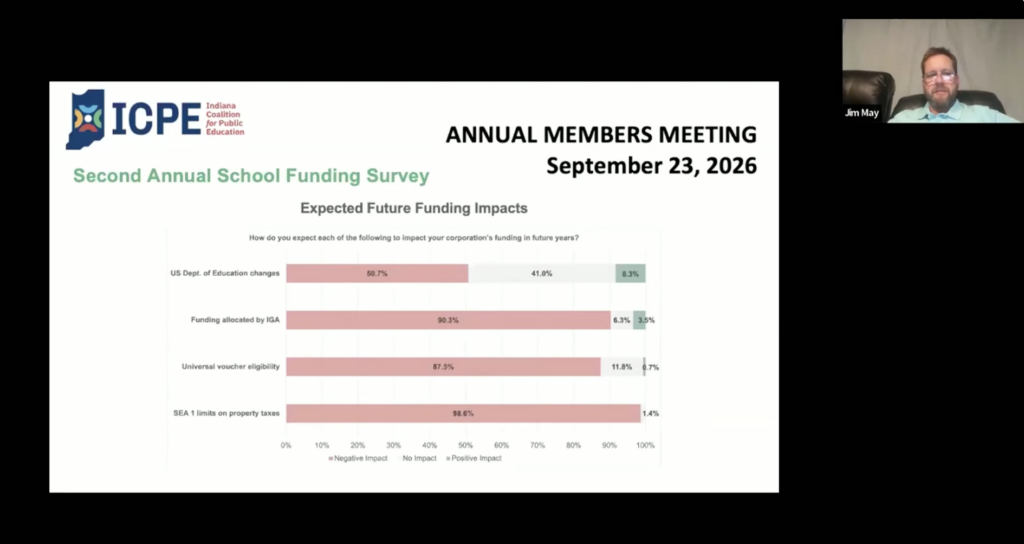
The survey was sent to superintendents at all 290 traditional public school corporations in Indiana. Responses were received from 144 corporations, and the responding districts were highly representative of the state’s overall population of traditional public school corporations in terms of rural, suburban and urban.
The responses describe school districts confronting a combination of declining or constrained revenue, rising costs, and impossibly difficult choices about what services to reduce. One superintendent from a rural corporation serving 1,000–1,499 students described the situation this way: “Our Operation Budget needs are $3.8M. We are anticipating falling $2.4M SHORT this year.” Another superintendent wrote that the district does not have a “reliable and predictable funding structure,” making long-term budgeting difficult. The funding crisis appears to be headed for a catastrophe.
Districts Are Already Cutting
The survey asked school corporations what they have done—or are considering doing—in response to funding shortfalls. The answers ranged from relatively small operational changes to significant reductions in staffing and services.
One rural district reported planting prairie grasses rather than mowing some of its property to reduce fuel costs, replacing lights with LEDs, removing televisions to reduce electricity use, and even starting a student-run business to create an additional income stream.
Another district serving more than 5,000 students reported eliminating 49 positions, including four administrators, 12 certified teachers, and 33 support staff. The district also reported that it had not provided a raise the previous year and was uncertain whether it could do so the following year. Other measures included increasing the distance students could live from school before transportation would be provided, eliminating transportation to special vocational programming, and adjusting HVAC settings to reduce energy costs.
These examples illustrate that school districts are not responding to funding pressures with a single strategy. They are looking across their entire operations for ways to reduce expenses.
How Much Funding Do Schools Say They Need?
Superintendents were also asked what level of funding would be needed to meet the expectations of their communities.The average response indicated that corporations would need an 8.0% increase in current funding to meet community expectations, followed by an ongoing annual increase of approximately 5.6%.
As one superintendent explained, revenue needs to at least keep pace with inflation simply to maintain expected services, while the costs of goods and services continue to rise. Another superintendent pointed specifically to teacher compensation, saying that even a significant increase in funding would be needed to address teacher pay adequately before the district could sustain more modest annual increases.
Referendums Are Becoming a Lifeline
The survey also examined school referendums. Among responding corporations, 14.4% reported seeking a referendum, compared with 13.1% of all Indiana traditional public school corporations.
For districts seeking referendums, the most commonly cited reason was SEA 1, identified by 64.7% of respondents. Other reasons included replacement of an expiring referendum, school safety and resource officers, enrollment growth outpacing funding increases, and the inability to maintain expected service levels with existing funding.
The districts that are not pursuing referendums face their own challenges. The most common reason was a lack of community support, followed by districts that are currently avoiding a referendum through cost reductions or are exhausting those cost-reduction options first.
The survey responses make clear that local districts are being forced to make incredibly difficult decisions as they try to balance community expectations with available resources.
Looking Ahead to the 2027 Legislative Session
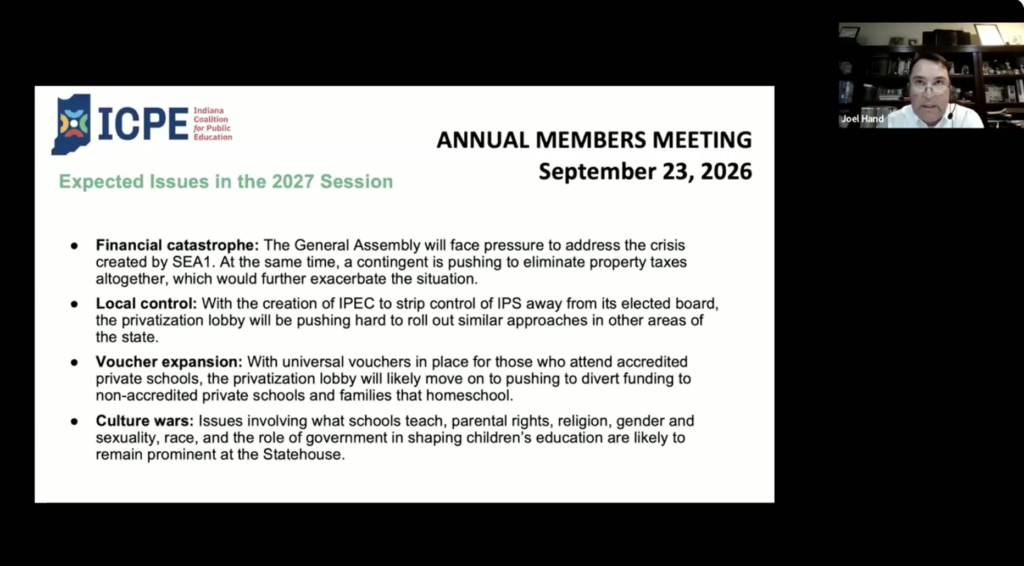
Our lobbyist and general counsel, Joel Hand, closed the substantive portion of the meeting with ICPE’s legislative forecast for 2027. He identified four major areas likely to dominate the upcoming session:
Financial Catastrophe
Hand expects the General Assembly to face pressure to address the financial consequences of SEA 1, while also facing a real push to eliminate property taxes altogether. The conflict between these policies and school funding, and the ultimate outcome, will be a crucial issue for public schools. We must be prepared.
Local Control
The creation of the Indiana Public Education Corporation (IPEC) and the changes to the governance structure of Indianapolis Public Schools raise broader questions about local control. Hand expects the privatization lobby to push for similar approaches in other parts of Indiana. Pointing to the bill that would have taken over the South Bend public school district but was pulled back and the bill that dissolved Union Township schools, Hand expects more of this government overreach in the upcoming session.
Voucher Expansion
Hand fully expects the expansion next session of Education Scholarship Accounts or ESAs, a form of voucher where students can purchase services, experiences or products with a debit card-like system using special education funds that would have gone to the public schools. Currently it is capped at $10 million and only applies to students with special needs and their siblings. Additionally, with the other more well-known voucher program, Choice Scholarships, being universal forstudents attending accredited private schools, Hand expects these vouchers may expand to non-accredited private schools and homeschooling families. He also expects “microschools” to find funding this session. Microschools are not defined in statute (yet) but are basically small groups of students in a place like a church basement or such, with an adult overseeing their education.
Culture Wars
Hand expects that we will continue to see bills involving what schools teach, parental rights, religion, gender and sexuality, race, diversity, equity and inclusion in education at the Statehouse next session. He expects the “culture wars to be reignited.”He also pointed out that these bills outrage the public, and effectively distract us from the very important work of ensuring that the budget bill supports our public schools. We must be very focused and grow our coalition. Hand urged us to be focused on electing public education supporters.
What Can Public Education Supporters Do?
The sum total of our meeting clearly pointed to a call for action between now and Election Day on November 3rd.Our ICPE president,Cathy, encouraged members and supporters to join ICPE , follow our calls to action, participate in grassroots meetings, volunteer, and use our #VotePublicEd resources on our website in order to learn where candidates and legislators stand on public education.
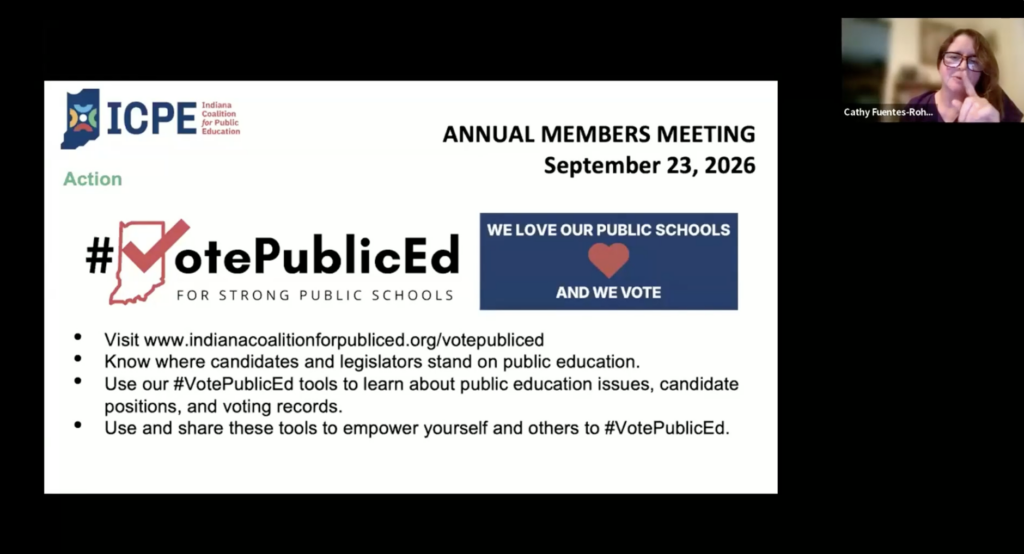
Cathy pointed to signs of hope: people are organizing, parents in IPS created an IPS Parent Council in recent years to inform their community and organize, our friend,MSD Lawrence Township school board president, Amy Norman, has been sharing with us all of the things that they are doing to raise awareness in their community, and people are waking up and learning. Many superintendents are saying the quiet part out loud: the state is failing us and our schools are in a financial crisis.
We need to work to inform our communities and to be engaged. We need more people to join our coalition, to strengthen our network of public education advocacy. Between now and November 3rd, we need to get off our keyboards and get involved in the process of getting public education advocates elected to all offices, up and down the ballot. #VotePublicEd
As we look toward our 17th year, the message from this year’s Annual All-Member Meeting was clear: the challenges facing Indiana’s public schools are significant, but so is the work being done by Hoosiers who believe public education should remain well-funded, accountable to its communities, and available to each and every child.