Guest Blog – The Hidden Losses of School Choice: A Student Perspective
The Hidden Losses of School Choice
By Talan Buell
The biggest takeaways I have from my time in high school come from show choir and theater. When I first became a freshman at Northrop High School in Fort Wayne, Indiana, I had zero interest in joining either program. I was a cross-country and long-distance track runner, not a singer, dancer, or actor. Imagine how shocked incoming freshman Talan would be to find himself in the audition room in May of his freshman year, preparing to join show choir as a sophomore and theater the next spring. Throughout my time in those two programs, I learned more real-world skills than in almost any traditional academic class. I often found my academic classes easy, so these two programs offered a unique challenge I could not find elsewhere. I learned how to work in large groups with people from vastly different backgrounds than my own, all striving toward the same goal of winning a competition or putting on an entertaining show. I learned how to lead by example, setting standards and living up to them for others. But I also learned something much more unsettling: these programs, much like many other extracurriculars critical to students’ high school experiences, were always near the cutting block.
“Every dollar used to subsidize a private education is a dollar stolen from the public good.“
Northrop is not a private school. It’s a public school in the Fort Wayne Community Schools district and thus reliant on public funding. When that public funding begins to disappear, the enrollment benchmarks programs must meet (the minimum number of students a program must serve to justify continuing to offer the course or extracurricular) get steeper and more unattainable, which leads to even more cuts and closures. I was incredibly fortunate to have excellent fine arts staff at Northrop who consistently kept their programs alive, but I wasn’t ignorant to the other high schools in the area losing funding, raising enrollment benchmarks, and cutting programs entirely. These are programs that build community and prepare students for their futures in ways academics alone cannot. And when programs like these disappear, it’s future generations of students who suffer most.
The constant risk of losing the fine arts is just one impact of the privatization of education. As is the case within our current political and economic system, those who benefit from privatization want to take a public good and turn it into a means of increasing their wealth. We’ve seen this playbook before with the public university system. What was once an affordable good meant to give all Americans a hand up has turned into an expensive commodity, forcing teenagers into extreme debt. Now the same interests that pushed to strip away affordable college are attempting to do the same to public primary and secondary education, this time under the new name of “school choice.” It sounds like a great idea: give families without the financial means to send their kids to private school the opportunity to afford the tuition.
The hidden reality is that the funding for these “choice” programs like vouchers, tax credit scholarships, and education savings accounts comes directly out of the budgets that public schools like Northrop depend on. Every dollar redirected to a private school is a dollar that doesn’t go toward keeping a fine arts program alive, keeping class sizes manageable, or keeping a necessary counselor in the building. And the “choice” itself is often an illusion. Private schools can reject students for disability, religion, academic performance, or a dozen other reasons that public schools legally cannot. A voucher doesn’t guarantee admission, it just rips quality from the standard public school. Meanwhile, the roughly 90% of Indiana students who attend public schools are asked to achieve more with less opportunity. Programs like the ones that shaped me get cut first, because they’re seen as “extracurriculars” rather than as the core of what a well-rounded education actually looks like. This should not be a choice that any administrator is forced into making. Every public school should receive the funding necessary to allow these impactful programs to grow and thrive, while still offering a quality academic experience. Every dollar used to subsidize a private education is a dollar stolen from the public good.
“Public education isn’t slipping because it’s public. It’s strained because it’s been starved.“
I don’t say any of this to romanticize my own experience. I say it because I know other students around the state do not have these same opportunities and every day every public school in Indiana walks closer and closer to that line. If Indiana keeps funneling public dollars into private alternatives, fewer and fewer students will get the opportunities I was lucky enough to have. Public education isn’t slipping because it’s public. It’s strained because it’s been starved. If we want the next generation of Indiana students to have the same shot to stumble into a program that changes their life and defines their high school experience as I did, we must fund our public schools. That starts with protecting public dollars for public schools. That starts with all of us demanding change within our state. That starts with everyone becoming the change we wish to see in our state.
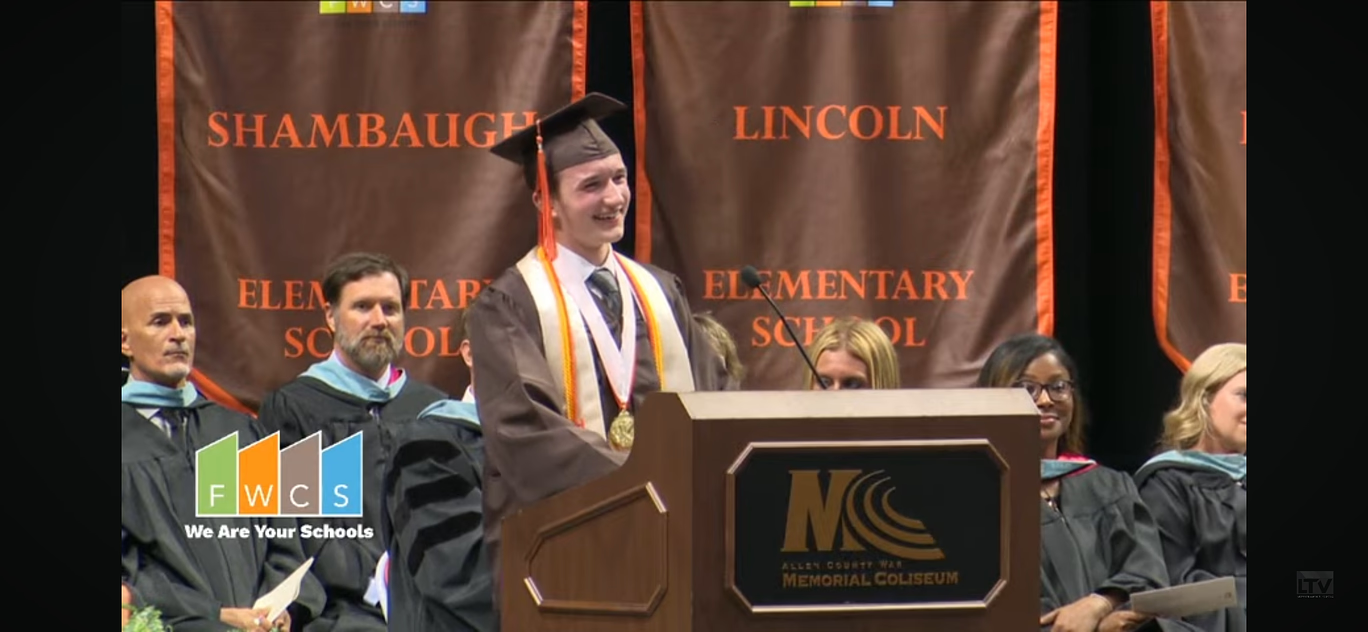
Talan Buell is the valedictorian of Northrop High School’s Class of 2026 in Fort Wayne, Indiana. During his time at Northrop, he participated in cross-country, track, show choir, and theater. He plans to attend Indiana University Bloomington to study law and public policy.
This guest blog is adapted from the graduation address Talan delivered to the Northrop High School Class of 2026.