
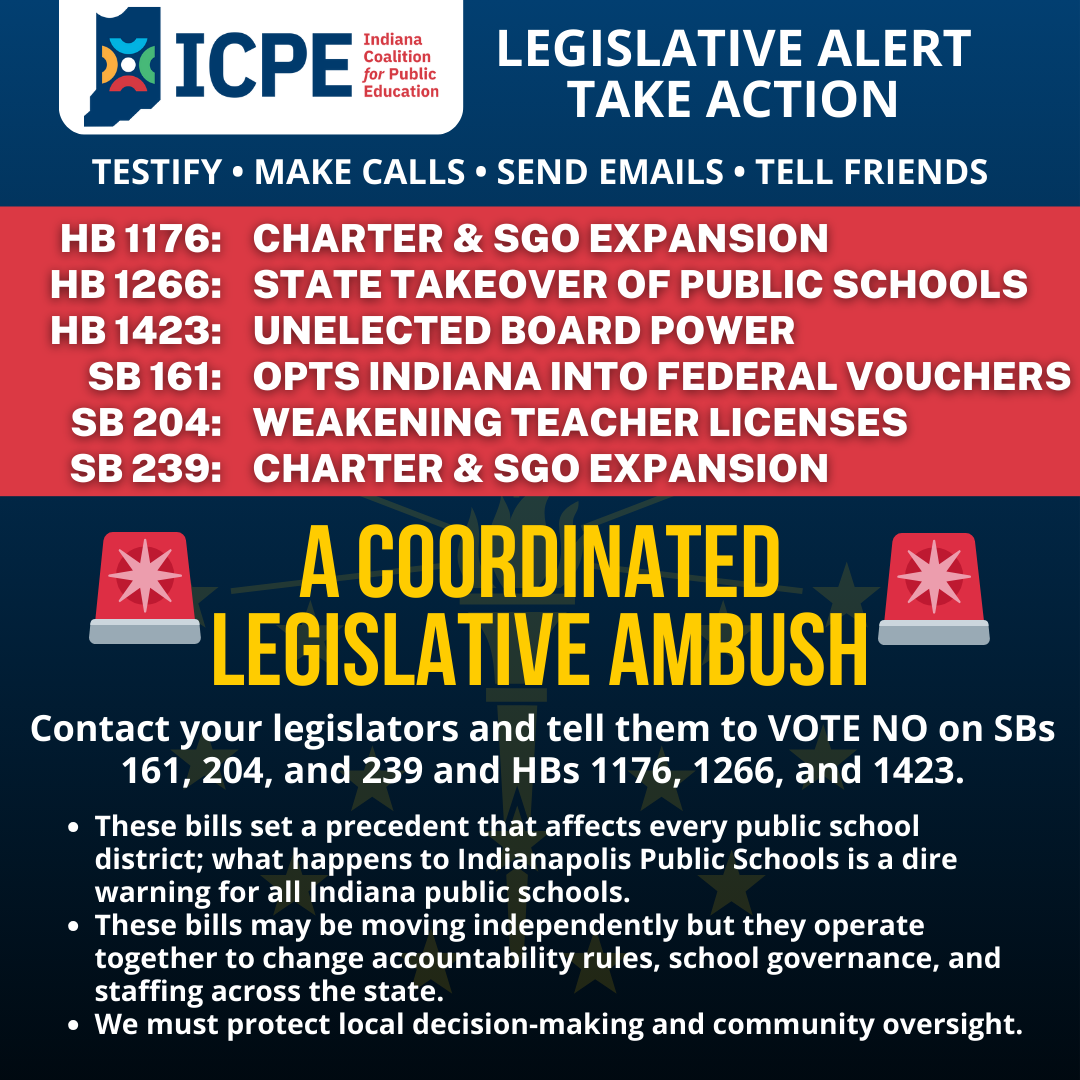
Multiple bills: A coordinated legislative ambush
Take Action Now
- Contact your legislators and tell them to VOTE NO on SBs 161, 204, and 239 and HBs 1176, 1266, and 1423.
Tell Five Friends, Make Two Calls (or More!)
Tell Your Legislators to Vote NO on House Bills 1176, 1266, and 1423 and Senate Bills 161, 204 and 239
When to call: Before Wednesday, January 21 at 8:30am
Why: House Bills 1176, 1266, and 1423 and Senate Bills 161, 204 and 239 take away local control, add unnecessary bureaucracy to public schools, and will allow more money to go to the wealthy
Who: Senate Education & Career Development Committee Members (see list below)
Phone: Senate: 800-382-9467
Message:
Hello, I’d like to leave a message for ___________________
My name is __________, and I am a ____________ (parent, grandparent, teacher, nurse, mom, dad, etc.).
What happens to Indianapolis Public Schools is a dire warning for all Indiana public schools.
Several education bills moving right now change accountability rules, school governance, and staffing across the state. These bills may be moving separately, but together they set a precedent that affects every public school district. These bills are HB 1176, HB 1266, HB 1423, SB 161, SB 204, and SB 239.
I’m asking [Representative/Senator] to protect local decision-making and community oversight and vote NO on these bills.
Please don’t rush permanent changes that affect every community school in Indiana.
Wednesday, January 21, 2026
8:30am, HB 1423 – Amend and Vote in the House Chamber by the House Education Committee. No testimony will be heard.
1:30pm, HB 1176 and HB 1266 – Amend and Vote in Room 404 by the House Ways & Means Committee. No testimony will be heard.
8:00am, SB 204 and SB 239 – Amend and Vote in Room 431 by the Senate Appropriations Committee.
More Details
What happens to Indianapolis Public Schools is a dire warning for all Indiana public schools.
The legislation moving through the General Assembly this session does not stop at one district, one city, or one school type. Policies that change accountability rules, expand conversion pathways, and restructure staffing and governance in Indianapolis set precedents that will apply statewide.
Bills such as HB 1176, HB 1266, HB 1423, SB 161, SB 204, and SB 239 operate together to reshape how schools are identified for intervention, how governance decisions are made and by whom, and how schools are staffed and operated once those changes occur. While each bill moves separately, the combined effect reaches every public school community — rural, suburban, and urban alike.
These decisions matter because once state policy changes the rules for one district, those same rules become the framework for all districts. All public school districts could be subject to similar future state actions if local governance structures are eroded or normalized as expendable.
Local school boards, educators, families, and communities deserve transparency, deliberation, and a voice before permanent changes to accountability systems, school governance, and staffing structures are enacted.
Now is the time to act.
Key Problems with these bills:
HB 1176 – Education matters – Vote NO
- Sharing of publicly funded resources with privately managed charter schools should be voted on by the community taxpayers. HB 1176 makes it easier to convert public schools into charter schools and expands innovation network schools without voter approval. It should not be decided by an appointed board created by statehouse legislation.
- SGO caps should not be eliminated. This policy prioritizes pre-tax vouchers for the wealthy at the expense of low-income students by siphoning resources from public schools that serve everyone.
- School boards should not be weakened. HB 1176 prevents school boards from both authorizing and partnering with innovation charter schools, forcing those schools away from local oversight and further separating them from the public education system.
HB 1266 – Department of education and education matters – Vote NO
- Public schools don’t need state intervention. They need to be fully funded.
- Taxpayers and children don’t need an added level of bureaucracy. By transferring control of school buildings and transportation from elected school boards to appointed centralized boards, this bill weakens local democracy and creates a framework that makes privatization easier and public accountability harder.
HB 1423 – Indianapolis public education corporation – Vote NO
- IPS and other Hoosier school districts do not need more bureaucracy and less local elected control. HB 1423 creates a new education corporation with an appointed board and gives it authority over public school funding and referenda. This is NOT economical and it weakens voter accountability.
- Decisions about public school funding should not be made by an unelected corporation. Taxing and governance authority should remain with elected school boards that are accountable to voters.
SB 161 – Education Matters – Vote NO
- Opts Indiana into the Federal Tax Credit Scholarship Program. This is a significant step toward the nationalization of voucher programs and elimination of public education.
SB 204 – Various Education Matters – Vote NO
- Allows charter-licensed teachers easier access to state licenses. Any individual with a bachelor’s degree and 3.0 GPA now has a pathway to becoming a licensed teacher without additional training or education.
- Eases licensure requirements (including degree pathways). Removes the limitation that the bachelor’s degree held by recipients of initial practitioner teaching licenses be in a STEM field.
SB 239 – Various Education Matters – Vote NO
- Allows multiple school conversions under one charter. Allowing multiple charter schools under one authorization would allow a governing body to convert all of its schools into charters with no local accountability.
- Expands innovation network charter reach. By allowing innovation network charter schools to operate beyond their original district boundaries, they would be subject to even less local oversight.
- Imposes financial penalties on districts for reporting failures. Schools late in meeting reporting requirements would have 25% of their financial support withheld by the state.
- Enables liquidated damages if buildings aren’t transferred fast enough. If it takes a school district more than 10 days to transfer ownership of a building under the $1 law, the charter can request damages of $10,000/day beyond the 10 days.
- SGO caps should not be eliminated. This policy prioritizes pre-tax vouchers for the wealthy at the expense of low-income students by siphoning resources from public schools that serve everyone.
* As always, please remember the following guidelines when reaching out to legislators:
- Remember to be polite and kind in your language and tone.
- Remind them public education is not a partisan issue.
- Encourage legislators to support legislation that strengthens public schools.
- Personal stories and anecdotes are particularly effective, whether it’s your own personal story or a close friend’s.
- Be disciplined in your messaging: the best way to build support for your position is to keep communication positive, bipartisan, inclusive, and single-issue.
- Avoid getting sidetracked with other issues you care about.
- If you are a constituent, mention that.