2026 Post-Session Review
This year we have moved our post-session review from an online live event to this blog post.
This session was unique. It was an extremely short session that began in December with a push by the Trump administration via Governor Braun for redrawing Indiana’s Congressional districts. The bill failed in the Senate. Some other bills had their first reading during those two weeks, such as Senate bills 76 (ICE bill) and 78 (Cellphone ban). The two weeks in December shortened the already short session that pressed along for 8 short weeks across January and February.
Thank You
If you were with us throughout this session, you know how much like the game of whack-a-mole the legislative session is and just how fast this short session went. If you shared one of our calls to action, attended an action party, wrote an email, called a legislator, THANK YOU.
With the exception of our lobbyist, Joel Hand, ICPE runs entirely on volunteer power and passion. The following individuals contributed an extraordinary amount of legwork this session. We’re deeply grateful for their efforts—especially because legislative sessions in Indiana often move quickly and unpredictably. An idea may appear in one bill one moment and surface in another the next, or a bill may get a slippery amendment, so getting the message out is frequently a last-minute push.
| Steve Brewer | Sarah Ferraro | Keri Miksza |
| Shelley Clark | Cathy Fuentes-Rohwer | Sharon Roulet |
| Larry DeMoss | Donna Kincaid | Michael Schaffer |
| Sue DeMoss | Jim May | Vic Smith |
How Active Were We?
In total, we tracked 61 education bills this session. 36 House bills and 25 Senate bills. Only 17 bills made it to the governor’s desk: 10 House bills and 7 Senate bills. Of those bills, by the end of the session, ICPE supported 2 bills, opposed 5, and were watching or neutral on 10 bills.
ICPE issued 11 calls to action, 8 of which involved HB 1423. And 4 of those calls to action were virtual group action parties, which was a new approach this session. Those calls to action covered 10 bills total that we deemed most important and pertinent to our mission. Of the 10 bills we issued Calls to Action (some calls to action contained multiple bills at once), 5 died. Of the 5 that died, 2 bills had concepts that were absorbed in some way into other bills.
We also held 4 legislative events on Zoom and in person around the state during the session.
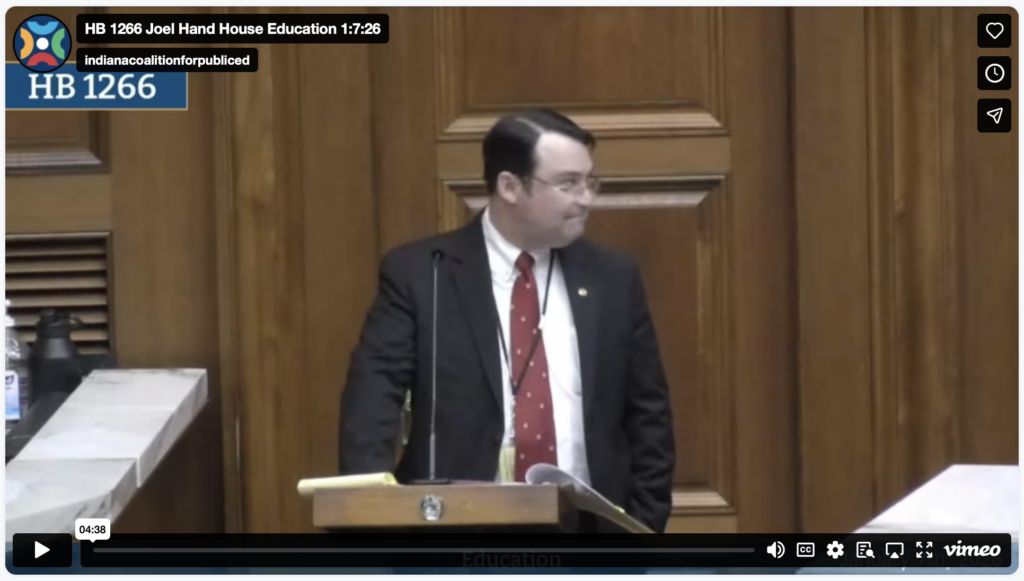
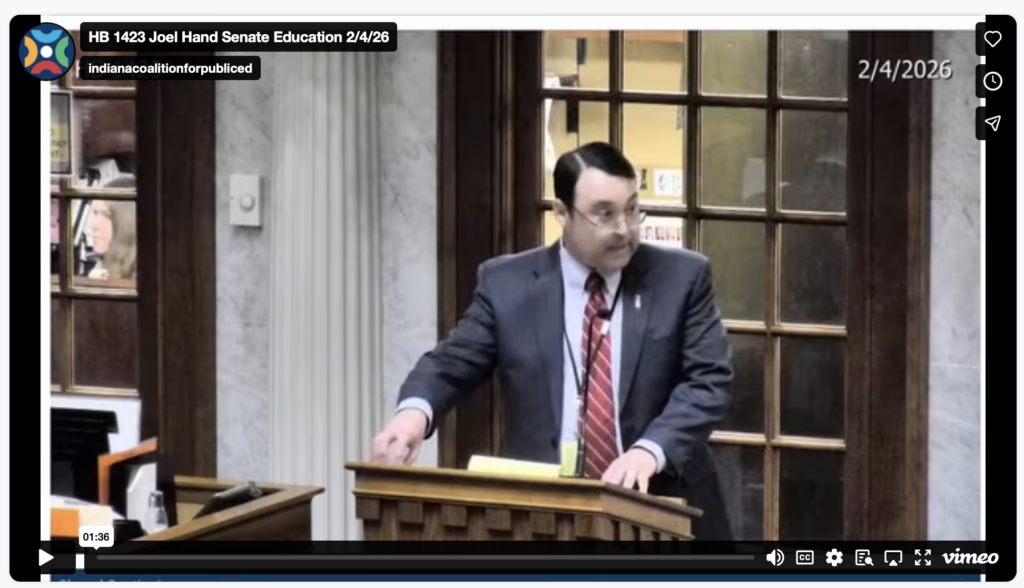
We are grateful for our lobbyist Joel who helped legislators write 1 bill and 23 amendments. He testified 12 times in the Statehouse. Joel also influenced amendments to 6 bills, making the bills better. He does a great job being our voice at the Statehouse, as you can see by clicking on the clips below.
This Session: Losing Local Democratic Control
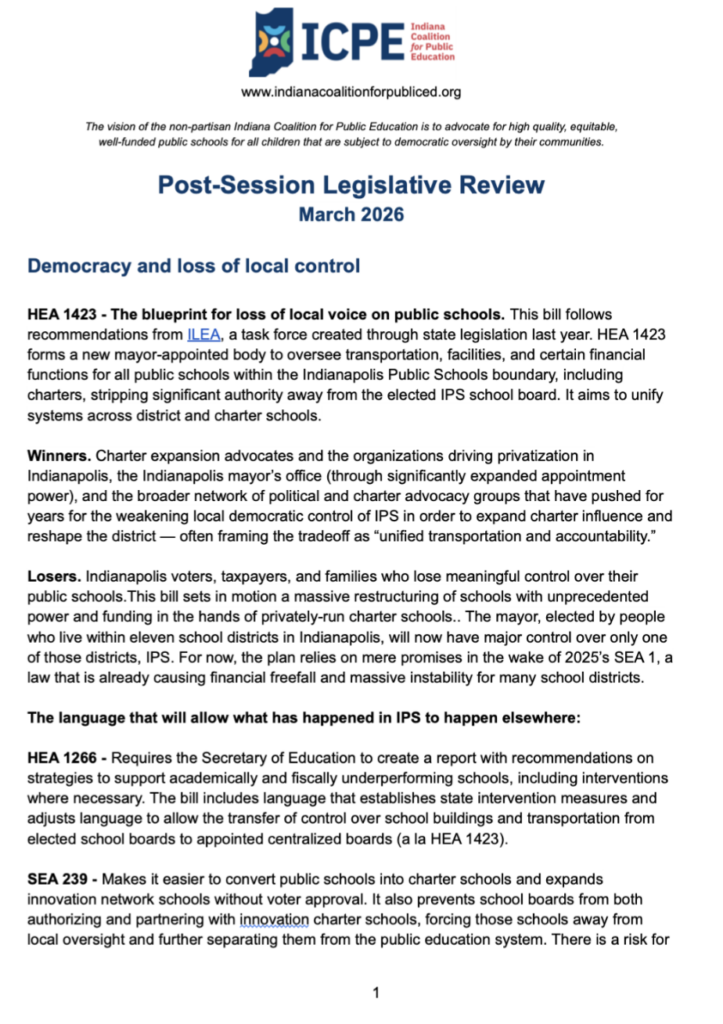
At the start of this session, our Indiana legislature worked to reject redistricting that was aggressively pushed on them by the federal government and outside interest groups. They objected to government overreach. The irony is that this same legislature—with the support of billionaire/outside interest-backed organizations like the Mind Trust—then went on to strip the democratic local governing voice and power of the Indianapolis Public School corporation (HEA 1423), handing it over to the non-elected board of a new corporation serving the interests of charter schools. This board will control facilities, transportation and even have the power to levy and distribute taxes. Overreach?
But it wasn’t just HEA 1423 and its taxation without representation that threatened democratic control over taxpayer-paid-for assets and our public schools. In SB 248 South Bend was nearly stripped of their right to elect school board members, giving it to the Secretary of Education to decide. That bill died–for now. Language in SEA 239 and HEA 1266 have created paths for other districts to hand over local elected control of school boards to appointed boards.
To hear what our amazing lobbyist Joel Hand had to say about the session, you can watch here.
Note: Did we mention this session was confusing? In the video, Keri said the federal SGO voucher language appeared in HEA 1408, but it actually ended up HEA 1266. Social media language eventually ended up in HB 1408 instead. Both ideas started in different bills at the start of the session.
You can access our 2026 legislative session summary handout here.
In Conclusion
Our greatest power to advocate for Hoosier students is in the voting booth. It is time to get involved in who and what will be on our ballot. Is your school system considering a referendum? Get involved. (We will be having an event on May 6 about referendum campaigns. Stay tuned). Do you know who is on the ballot and how they stand on public education issues? We worked hard to raise our voices for our public school kids and it fell on many deaf ears. If we can’t change legislators’ minds, we must change the legislators (or whatever elected officials) themselves. We must send the message: We love our public schools and WE VOTE.
ICPE is a nonpartisan organization. The reality is that attacks on public education have come from both sides of the aisle—and it will take a bipartisan pushback to stop and reverse the damage. Democrats in cities like Indianapolis have embraced privatization through charter (and innovation) schools, while Republicans, holding a supermajority, have successfully expanded universal vouchers and expanded the charter school efforts..
At its core, politics is about your relationship to power. Right now, we are in a power struggle over the health, vitality, and future of public education in this state and across the country. When rural school communities recognize that their fate is tied to the fate of urban school communities, our movement will grow stronger—and we will win. Until then, the most important step in our advocacy is continuing to inform and engage our communities so that everyone will #VotePublicEd.