
HB 1423 and the Future of IPS
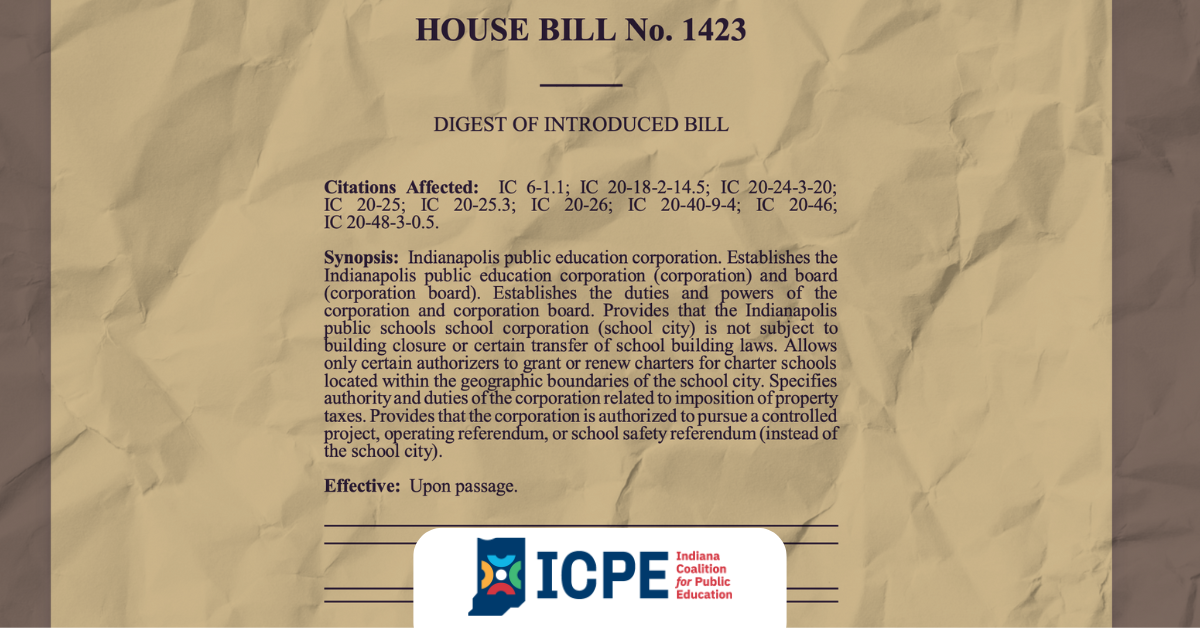
On Monday, January 12, the House Education Committee heard HB 1423, a bill that would radically restructure Indianapolis Public Schools. The proposal would strip the democratically elected IPS school board of authority over school buildings and transportation and impose unified standards on both charter and traditional public schools within the district.
The bill would also create a nine-member board appointed by the mayor, granting this unelected body the power to levy and distribute taxes. Throughout the hearing, one concern was raised repeatedly: this is taxation without representation. What happens to parent voice? What happens when control of a public good is taken away from the public? What happens when public schools, accountable to their community and the public, become accountable only to the mayor? Three political science professors wrote a piece in the Indianapolis Star raising such questions. To be clear, ICPE stands unwaveringly for local democratic control of public education, so that schools remain accountable to the communities they serve.
Deeply concerning issues aside, so many logistical questions remain. To promote stability and equity in the Indianapolis Public Schools community, ICPE Board member Dr. Gayle Cosby—an educator and IPS school board member— authored the following white paper proposing a unified structure that centers neighborhoods in future decisions about enrollment, building use, school programs, and transportation. Whatever happens to IPS following this session will have serious implications for school districts all across the state. Please contact your legislators and encourage your local school board members to speak out on this anti-democracy bill. Your school district could be next.
Zones for the New Indianapolis Educational Landscape
Subtitle: Utilizing Geographic Stabilization to Mitigate Fiscal and Logistical Risk in State-Mandated District Consolidations (HB 1423)
Date: January 11, 2026
Author: Dr. Gayle Cosby, PhD
Principal, Gayle Cosby PhD LLC
EXECUTIVE SUMMARY
The introduction of HB 1423 creates a new governing entity—the Indianapolis Public Education Corporation (IPEC)—with the authority to oversee unified enrollment and transportation. However, without statutory mandates for Geographic Zoning, this transition risks systemic fiscal collapse due to duplicative transportation costs and neighborhood destabilization. This brief outlines a technical expansion of the Indianapolis Public Schools (IPS) “Rebuilding Stronger” (RBS) framework to provide legislative guardrails for logistics regarding the Indianapolis area consolidation of all schools in the educational landscape.
THE PROBLEM: THE “LOGISTICAL VACUUM”
Under the current proposed legislation, specifically HB 1423, charter schools may receive property tax distributions without being required to adhere to district efficiency standards. This creates:
- Fiscal Leakage: Public funds are exhausted on cross-city “choice-based” transportation rather than classroom instruction. Indianapolis Public Schools has lowered the per-pupil yellow bus transportation cost to $2,300 following RBS implementation. All schools now operating with increased taxpayer funding should be held to the same standard of efficiency.
- Neighborhood Churn: Without consideration given to the number of seats in a zone and the programs and curricula offered within it, the cycle of oversaturation exacerbates. This is a documented problem for both charter and traditional public schools. Neighborhood schools lose their role as community anchors, leading to “predictive” cycles of school closure that are at risk of continuing without a structure to determine logistical reasoning why schools must close.
- Opportunity for Enrollment Alignment: The unified enrollment system Enroll Indy is being redeveloped alongside the implementation of IPEC. This is a prime opportunity to reconfigure enrollment for all schools based on geographic zone to ensure compliance.
THE SOLUTION: THE RBS EXPANSION FRAMEWORK
To preserve the public district’s integrity, the state must codify Geographic Zones as the primary organizational unit for all schools under the IPEC.
I. Mandatory Enrollment Alignment
- Zone Priority: All schools within the Corporation jurisdiction shall prioritize enrollment for students residing within their designated geographic zone.
- Charter Integration: Charter schools authorized within IPEC boundaries shall function as neighborhood-priority assets, reducing “churn” and stabilizing local enrollment.
II. Unified Transportation Covenants
- Funding Hook: Access to Corporation-managed transportation funds shall be contingent upon a school’s adherence to the unified routing map.
- No Duplication: Public funds shall not be utilized for transportation that duplicates existing district routes or moves students across zones when an equivalent seat is available within-zone.
III. Governance & Accountability
- Advisory Councils: Each of the four zones shall be governed by a Zone Advisory Council comprised of local educators, parents, and community employers (e.g., Lilly, IU Health) to ensure the school-to-workforce pipeline is localized and provides the cooperation needed to meet high school diploma requirements of internship hours.
- Data-based School Authorization: New schools shall be prohibited from opening within any geographic zone where less than 85% of current schools are operating at or above 95% enrollment capacity. This threshold will be applied separately for schools in their respective sector (IPS or charter) for serving students in K-5, 6-8, and 9-12.

LEGISLATIVE “SHALL” RECOMMENDATIONS FOR HB 1423
- The Corporation shall establish binding geographic zones modeled after existing IPS RBS boundaries for enrollment, transportation, and the application of data-based thresholds for the opening of new schools.
- Charter school participation in property tax revenue shall require documented compliance with the Corporation’s unified logistical framework.
- DEBT PROTECTION: The “March 31 Debt Freeze” shall be delayed until the IPEC Board is seated and has a ratified Master Facilities Plan to prevent emergency infrastructure failure in IPS buildings. A review of all dates proposed in HB 1423 is prioritized to ensure continuity.
ABOUT THE AUTHOR
Dr. Gayle Cosby, PhD, is an elected Commissioner for Indianapolis Public Schools and an ICPE Board Member.